
I Love Teaching Art… So Why Am I Googling Other Careers at 9PM?
You didn’t choose this job because it’s easy.
You chose it because you love watching students create something they didn’t think they could.
You love the messy tables.
The “wait — I did that?” moments.
The breakthroughs.
And yet, some days you still end up sitting in your room after school thinking:
Why does this feel so much harder than it should?
Usually, it’s not the big things that wear you down. It’s all the little things that pile up throughout the day.
The missing pencils.
The repeated directions.
The wandering for supplies.
The cleanup that somehow takes forever.
None of those things seem huge on their own, but together they can make teaching feel much harder than it needs to.
Over the years, I’ve found that a few simple classroom systems can make a surprisingly big difference.
They help students know what to do, reduce the number of little interruptions, and make the room feel calmer and easier to manage.
This guide walks through the art classroom systems I use to reduce friction, make expectations clearer, and help the day run more smoothly.
The goal isn’t to create a perfectly organized classroom.
It’s to build a few reliable systems that make teaching easier and give you more time and energy for the parts of the job you actually love.
If You’ve Ever Answered the Same Question Five Times in Ten Minutes
If you’ve ever felt your patience slipping before the period is even halfway over…
If you’ve ever watched a student rush through something you carefully planned and thought, You’re capable of more than this…
If cleanup somehow turns into the longest five minutes of your day…
And if you teach art — with larger classes, more materials, more movement, and more personalities than most rooms can hold — you know it’s different.
The phone rings.
A counselor calls a student down.
Another teacher pops in asking to borrow supplies.
The bathroom list starts forming before you’ve even finished taking attendance.
You’re managing creativity and interruption at the same time.
It’s a lot.
For me, the biggest shift came when I stopped looking at every little frustration as a student problem and started asking:
What can I adjust?
I made a list of the small things that were creating unnecessary friction.
The loud pencil sharpener across the room.
Students wandering for supplies.
Broken pencils with no erasers.
Cleanup stretching longer than it needed to.
Then I started changing the systems around those problems.
I removed the loud sharpener.
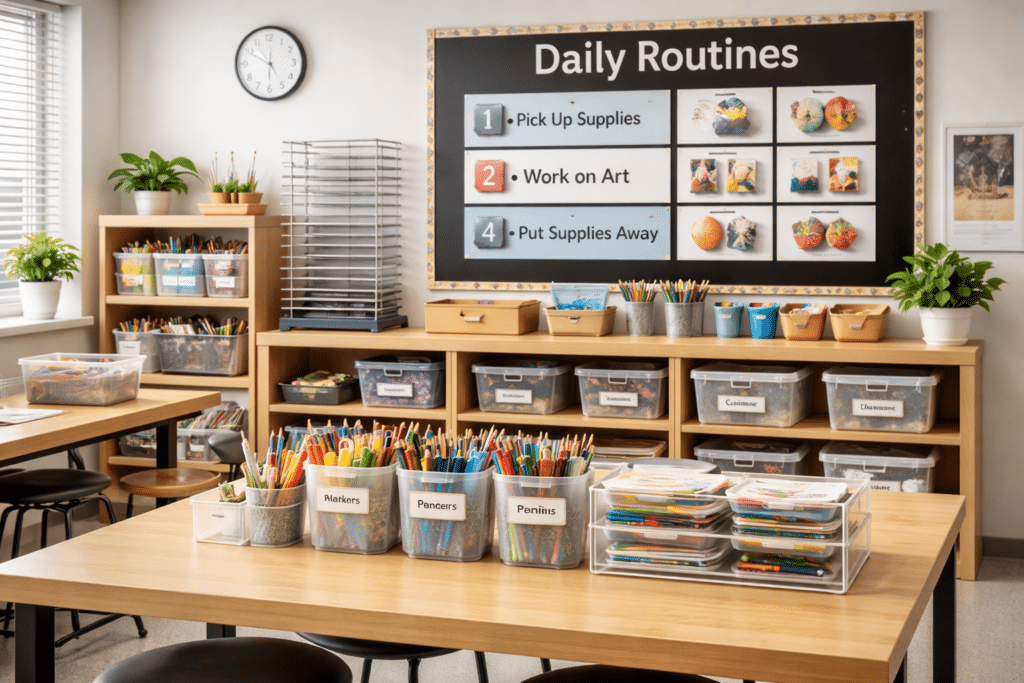
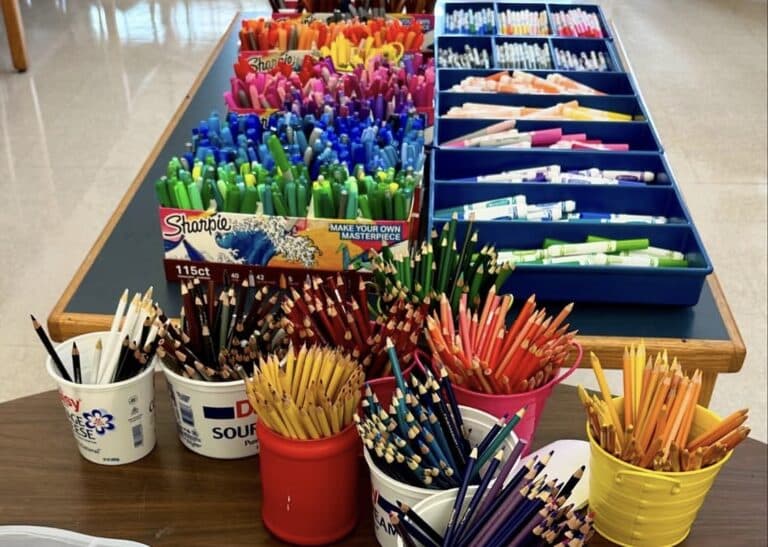
I kept frequently used supplies within easy reach.
I made routines more predictable.
And after I give directions, I do something simple.
I smile and say:
“NOBODY is going to ask what we do next… right?”
Then I clap once — big and dramatic — enough to wake the sleepers.
And I say:
“I get it. I tune out in faculty meetings too. There are 36 of you and one of me. I’ll come around like I always do. But this is the one thing everyone needs to hear before I get there.”
I’ve learned not to expect one whole-group explanation to reach every student.
So I walk the room.
I reteach in small groups.
I answer questions in proximity.
I build connection while I’m doing it.
Those little systems don’t make the classroom perfect.
They just make the day run more smoothly.
Less wandering.
Fewer repeated interruptions.
More time for teaching, creating, and connecting.
Design for Autopilot Instead of Fighting It
In a world full of noise, screens, interruptions, and too much information, our brains have to filter.
They delete.
They fill in gaps.
They make fast guesses.
They have to.
We can’t possibly absorb everything around us all the time.
That’s true for students.
And it’s true for us.
It’s why they miss directions sometimes.
It’s why we miss emails.
It’s why we walk into a room and forget what we came for.
It’s not always carelessness.
Sometimes it’s just filtering.
When I started thinking about that differently, something shifted for me.
Instead of taking every missed step personally, I started teaching students what was happening inside their own brains.
I’ll say:
“If I asked you what color sweatshirt I wore yesterday, most of you probably couldn’t tell me.”
They laugh.
Then I explain that it doesn’t mean they weren’t paying attention.
It just means their brain decided that information wasn’t important enough to save.
That’s what brains do.
Then I connect it to art.
Your brain is going to want to rush.
Your brain is going to want to add detail too early.
Your brain is going to think that if something doesn’t look good immediately, you’re bad at art.
That’s normal.
It’s autopilot.
I explain this to the whole group, and then I repeat it casually as I walk around the room.
So when a student starts rushing or getting frustrated, I can say:
“Remember what we talked about?”
Now they don’t feel like they’re being corrected.
They feel like they understand what’s happening.
And when a student pauses, looks again, and catches something they missed, I celebrate it.
Sometimes I’ll literally fist-pump and say:
“YES. You’re winning.”
I exaggerate it on purpose.
Because a lot of students have learned to think that noticing a mistake means they failed.
I want them to understand the opposite.
Catching it means you looked again.
It means you noticed something.
It means you’re building skill.
That moment — noticing your own thinking and choosing to adjust — is something worth celebrating.
The more students understand that, the less afraid they become of being wrong.
They start looking again on purpose.
They start noticing what they missed.
They become more willing to revise instead of rushing forward.
Instead of fighting autopilot, we name it before it shows up.
And when students understand what’s happening, defensiveness drops and ownership grows.
Systems That Protect Your Peace

There was a point where I could feel my eye twitch every time I heard:
“What do we do next?”
Not in a dramatic, I need a new career kind of way.
Just in a very real, I love this job and I want to feel good doing it kind of way.
I remember thinking:
If I’m going to keep doing this for years, I don’t want to spend my energy fighting the same little problems every day.
So I stopped trying to power through the friction and started smoothing it out.
I built slideshows so directions didn’t disappear into the air.
I posted references so students didn’t have to rely on memory.
I created visual checkpoints so progress felt clear instead of chaotic.
Nothing changed overnight.
But little things got easier.
Fewer repeated questions.
Less wandering.
Smoother transitions.
More independence.
The room was still busy and creative, but it felt steadier and more intentional.
Students weren’t just finishing projects.
They were learning how to manage themselves inside the process.
The Core Art Classroom Systems That Make the Biggest Difference
These are the systems that have made the biggest difference in my classroom. You don’t need to overhaul everything at once. Even improving one or two of these areas can make the day run more smoothly.
1. Expectation Systems
Students do better when expectations are clear and easy to find.
I try not to let important routines live only in my voice. I write them down, post them, and refer back to them consistently.
Your syllabus can be part of that system too. It helps establish expectations before problems ever come up.
I explain how I structure mine in How Your High School Art Class Syllabus Sets the Tone for Classroom Management Success.
2. Workflow Systems
Students work more independently when they can see where they are in the process and what comes next.
Clear checkpoints, reflection, and digital documentation help students track their progress instead of constantly relying on you to tell them what to do next.
I use Padlet as part of that workflow, and I explain exactly how in How I Use Padlet as a Digital Documentation & Accountability System in My Art Classroom.
3. Transition and Instruction Systems
A surprising amount of classroom stress happens during transitions.
Getting supplies.
Sharpening pencils.
Moving from demonstration to work time.
Cleaning up.
Figuring out what comes next.
The more predictable those routines are, the less time you spend stopping the class to manage them.
Visual directions, modeled routines, and consistent cleanup procedures make a huge difference.
You can find more of the everyday routines I use in my Art Teacher Tips.
4. Substitute Systems
A good substitute system should make the day easier for everyone — you, the substitute, and your students.
Clear procedures, familiar routines, and ready-to-use plans help protect the classroom structure even when you aren’t there.
I walk through how I prepare in How to Prepare for a Substitute Teacher in the Art Room.
5. Lesson Design Systems
The way a lesson is structured can either support your classroom systems or work against them.
Clear steps, strong examples, predictable checkpoints, and built-in opportunities for students to reflect make it easier for them to work independently.
Strong lesson design doesn’t just improve the artwork.
It makes the room easier to manage.
You can explore examples in High School Art Lessons and Projects.
When these systems work together, students know what is expected, where to find what they need, and how to keep moving without waiting for you to solve every small problem.
And that gives you more room to do the part of teaching that matters most:
helping students create, problem-solve, and grow.
If You Only Change Three Things
If you’re feeling overwhelmed, don’t try to change everything at once.
Start here:
• Clarify expectations before behavior becomes a problem.
Write them. Post them. Repeat them. Make important expectations easy for students to find.
• Reduce repeated explanations with visual systems.
Use directions, examples, and checkpoints so clarity doesn’t live only in your voice.
• Design transitions instead of reacting to them.
Think through supply access, sharpening, cleanup, and “what’s next?” before those moments become daily frustrations.
Trust Is Built in the Small Moments
Students are constantly reading the room.
They notice tone.
They notice body language.
They notice how mistakes are handled.
They notice whether the room feels safe.
Classroom culture isn’t created in one big moment.
It’s built through hundreds of small ones.
The way directions are repeated.
The way correction is delivered.
The way effort is acknowledged.
The way frustration is handled.
Those small interactions teach students what kind of room they’re in.
So when someone tests a boundary — and they will — the whole class is less likely to unravel because the expectations and tone are already familiar.
Most students don’t respond to volume.
They respond to consistency.
When the environment feels steady and respectful, students begin to settle into it.
Not because they’re being controlled.
Because they know what to expect.
Trust builds quietly over time.
And once students trust the environment, they’re much more likely to take risks, recover from mistakes, and stay engaged in the work.
What Teaching From the Inside Out Really Means
Teaching from the inside out isn’t about adding one more strategy.
It’s about understanding how your own state affects the room — and how much easier teaching becomes when you anticipate friction instead of constantly reacting to it.
It means understanding how the brain works, yours and your students’.
It means helping students notice what’s happening before frustration takes over.
It means celebrating awareness, revision, and growth instead of treating every mistake like a problem.
And it means building systems that help the classroom feel steady enough for everyone to do their best work.
Students notice our tone.
They notice tension.
They notice how we respond when things go wrong.
When the adult in the room is grounded and consistent, students feel that too.
Inside Out Art Teacher was never just about projects.
It’s about helping students become more aware of how they learn, how they respond, and how they grow.
And it’s about helping teachers build classrooms that feel manageable, meaningful, and sustainable.
You don’t need a perfect classroom.
You just need fewer things working against you — and a few systems that make it easier to focus on the parts of teaching you love most.
That’s what teaching from the inside out means.
Ready to Reset Your Art Room Systems?
If you want a place to start, download the Art Room Systems Reset Checklist included with the Free Substitute Teacher Binder.
A Few Art Teacher Shirts That Get It
“If your classroom runs on creativity, routines, and a healthy sense of humor, these might feel a little too familiar.”