black history month art
Every February, there’s a familiar moment in art class.
Students walk in already knowing it’s Black History Month… they’ve seen the posters, the announcements, the calendar reminders, but they’re not always sure what that means in this room.
You can almost feel the expectations hovering.
Some students assume it’s going to be a worksheet day.
Some brace for a quick slideshow and a rushed project that feels more like a checkbox than an experience.
And a few are already halfway disengaged, waiting for it to feel “school-ish” instead of creative.
And if we’re being honest?
A lot of teachers feel that same tension.
We want our Black History Month art projects to matter.
We want to highlight Black artists thoughtfully and respectfully.
We don’t want anything that feels performative, rushed, or like a one-month-only add-on.
But we’re also teaching real classes…with limited time, mixed skill levels, reluctant students, and projects that actually have to work with 25–30 kids in a room.
Over time, I’ve learned that the Black History Month lessons that land best aren’t the loudest or the most complicated.
They’re the ones that:
- let students tell stories instead of copying images
- don’t require advanced drawing skills to succeed
- give space for reflection without turning into a lecture
- and result in artwork students are genuinely proud to display
The three Black History Month art activities I’m sharing here are the ones I keep coming back to for exactly those reasons.
Each one introduces students to influential Black artists and ideas, while still honoring what art class is supposed to be: creative, hands-on, thoughtful, and accessible to everyone in the room.
If you’re looking for Black History Month art projects that feel intentional for middle or high school, these are solid, classroom-tested options to have ready when February rolls around.
For more classroom ideas throughout the year, browse this collection of seasonal art activities for middle and high school art classes.
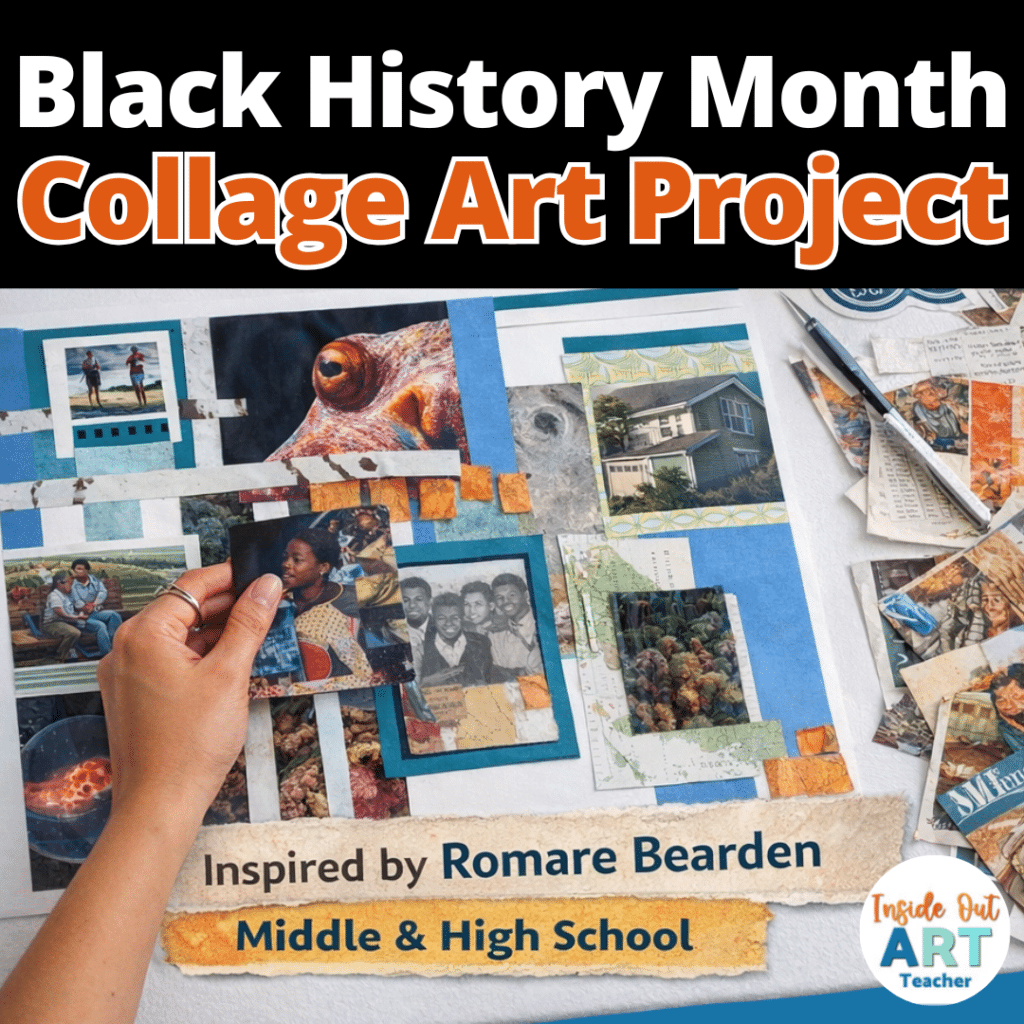
1. Romare Bearden–Inspired Collage
A Black History Month art project that feels personal, not performative

If there’s one Black History Month art project I keep coming back to, it’s this one.
Not because it’s trendy.
Not because it looks impressive on day one.
But because it’s one of the few projects where every student can actually get started without that panic setting in.
When I introduce students to Romare Bearden, there’s always a pause.
They’re expecting something realistic.
They’re expecting a face they have to copy perfectly.
They’re expecting rules.
And then they see his work.
It’s cut up.
Layered.
Pieces don’t quite match.
Faces shift. Spaces overlap. Nothing feels overly polished.
And instead of saying, “I can’t do this,” students lean in.
Bearden’s collages feel the way memories actually feel…a little messy, emotional, layered on top of each other. Family, music, movement, everyday life all living in the same space.
That’s the moment this project clicks.
Students stop worrying about whether they’re “good at art.”
They stop comparing their work to the kid next to them.
And they start thinking, How do I show this moment?
That shift is everything.
If you’re curious about the exact steps I use to run this project from start to finish, I’ve shared a full walkthrough in this post.
What it looks like in class
The lesson starts with students looking at Bearden’s work through a guided slideshow, not a heavy lecture, not an overwhelming worksheet.
They notice:
- overlapping imagery
- repeated shapes
- figures broken apart and reassembled
- crowded or intentional use of space
Then students choose a personal memory to build their collage around. Nothing forced. Nothing overly heavy. Just something real.
Because there’s no drawing requirement, students who usually shut down are suddenly participating. They’re cutting, arranging, moving pieces around, making decisions.
The room feels focused. Not silent, not chaotic.
And when they reflect at the end, something powerful happens:
students connect personal storytelling to Black history without being told exactly what to think.
That’s the kind of Black History Month art project that sticks.
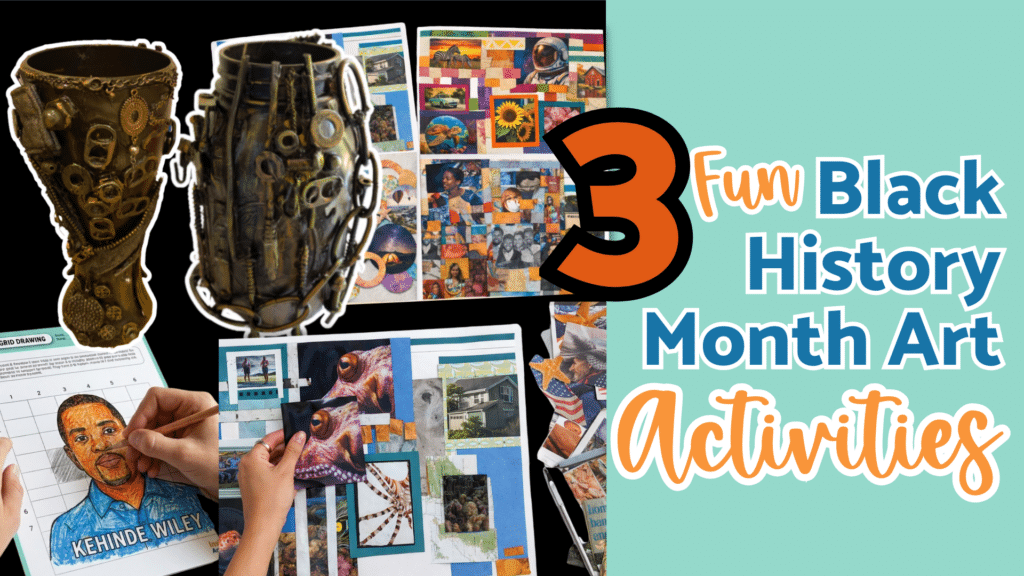
2. Assemblage 3-D Art Project Inspired by Betye Saar
When students need to work in 3D and think symbolically

This project is a favorite when you want to push students just a little further without losing them.
Inspired by Betye Saar, this Black History Month art project introduces students to assemblage and symbolism through found-object sculpture.
Instead of drawing or painting, students build.
They use everyday objects to represent:
- their past
- their present
- their future
And suddenly, art feels… different.
Students who struggle with two-dimensional work often thrive here. The tactile nature of assemblage gives them something concrete to hold onto.
Why teachers love this one
This lesson balances structure and freedom in a really satisfying way.
Students are guided through:
- selecting meaningful objects
- thinking symbolically (instead of literally)
- layering materials intentionally
- explaining why something represents an idea
It’s reflective without being overwhelming.
Deep without being heavy-handed.
And because each sculpture is rooted in personal meaning, no two projects ever look the same even though everyone starts with the same framework.
This is a strong Black History Month art project when you want:
- thoughtful discussion
- meaningful symbolism
- and display-worthy work that doesn’t feel cookie-cutter
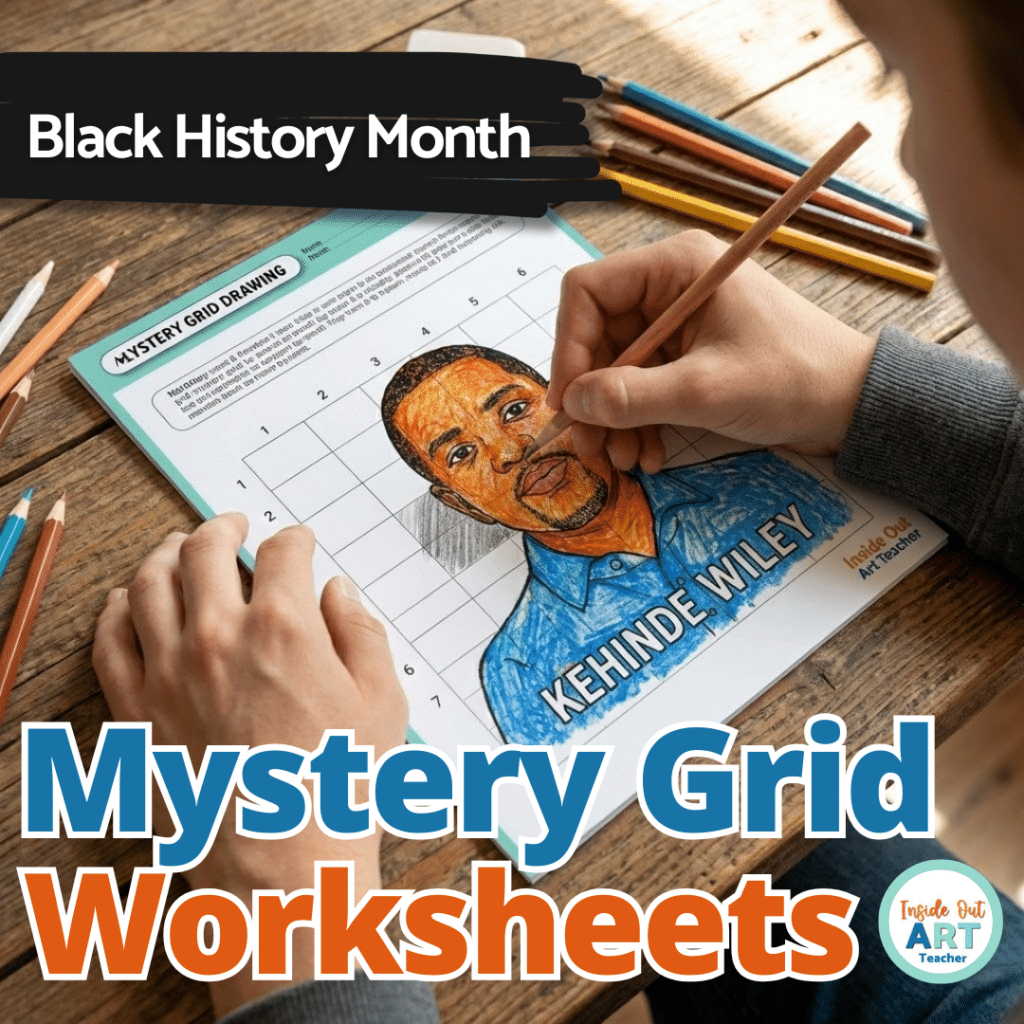
3. Black History Month Mystery Grid Worksheets
When you need engagement, focus, and a calm win

Sometimes February needs a different kind of energy.
Not every day can be deep reflection and multi-day projects.
Sometimes you need something that hooks students immediately.
That’s where the mystery grid worksheets shine.
Students work through a grid, one square at a time, and slowly reveal portraits of influential Black artists like Jean-Michel Basquiat, Kehinde Wiley, Faith Ringgold, and Amy Sherald.
And yes, it feels like a game.
But it’s also quietly doing a lot of work:
- strengthening observation skills
- reinforcing grid drawing and proportion
- building persistence
- keeping students focused far longer than expected
This is a go-to for:
- one-day lessons
- early finishers
- sub plans
- days when attention spans are thin
Even reluctant students get pulled in because curiosity takes over.
Looking for Black History Month Art Lessons You Can Actually Count On?
Whether you use one lesson on its own or rotate all three throughout February, the goal stays the same:
- keep students engaged
- honor Black artists thoughtfully
- and give yourself lessons that feel calm, meaningful, and doable
If you’ve been looking for Black History Month art activities that actually work in real classrooms, with real time limits and real students, these are the ones I keep coming back to.

Be the first to know about discounts, freebies, and new resources!
Find me on my blog – Inside Out Art Teacher, YouTube, or Instagram.